
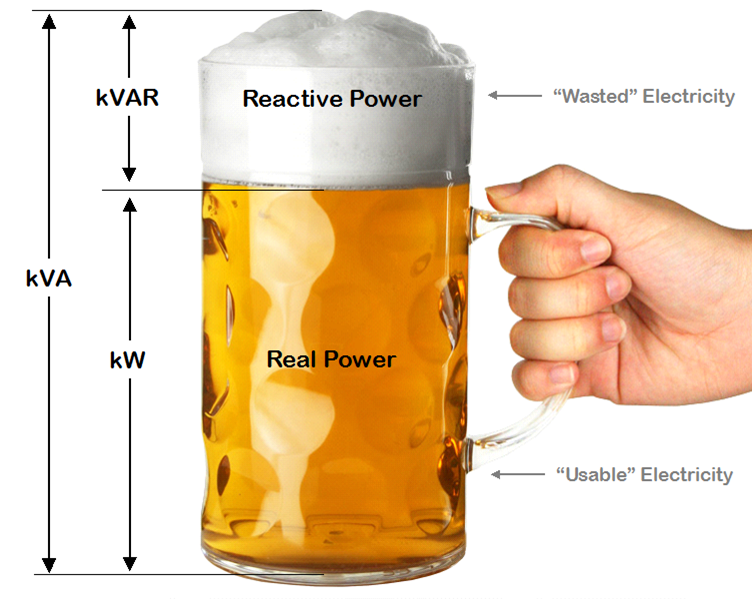
The power factor is defined as the ratio of real power to apparent power. As power is transferred along a transmission line, it does not consist purely of real power that can-do work once transferred to the load, but rather consists of a combination of real and reactive power, called apparent power. The power factor describes the amount of real power transmitted along a transmission line relative to the total apparent power flowing in the line.
Power Factor of a load indicates the percentage of useful power that does work across a load
While reactive power is the percentage that does no work used to maintain the electromagnetic field
Power Factor, pf, cos =
=
Reactive factor ,rf, sin
=
=
A higher power factor implies more of the power supplied is used for work while a lower power factor implies there is more power wastage and less efficiency of the load network
An everyday example of power factor occurrence is in an electric power system where a load with a low power factor draws more current than a load with a high-power factor for the same amount of useful power transferred. The higher currents increase the energy lost in the distribution system, and require larger wires and other equipment

Also, Power factor correction are applied by an electric industrial company to improve the stability and efficiency of the load network. using capacitors (which supplies magnetizing Vars) or inductors (which absorbs magnetizing Vars) , by correcting the power factor the current and voltage are brought close to phase alignment , the power factor is increased and the efficiency of the network increases, while the reactive power decreases and companies pay less electric bills since electricity utility companies charge big industrial companies penalties on high reactive power consumption that is low power factor loads

 Advancing Science and Technology in Africa